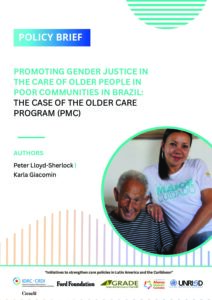
Promoting gender justice in care for older people in poor communities in Brazil: The case of the Elder Care Program.
| Year | : | 2025 |
|---|---|---|
| Author/s | : | Peter Lloyd-Sherlock, Karla Giacomin |
| Area/s | : | Ethnicity, gender and citizenship |
Lloyd-Sherlock, P. & Giacomin, K. (2025) Promoting gender justice in care for older people in poor communities in Brazil: The case of the Older Care Program. [Policy brief] Initiatives Project to Strengthen Care Policies in Latin America and the Caribbean.
This policy brief gathers the findings of the study on promoting gender justice in the care of dependent elderly people in vulnerable communities. The research assesses the impact of the Maior Cuidado Program (PMC) —launched in Belo Horizonte and expanded to municipalities like Salvador and Contagem— which provides between 10 and 20 hours of home support per week through paid and trained caregivers.
The study shows that the program reduces the burden and physical strain on caregiving families, while formalizing a public workforce with labor rights and helping to reduce poverty in households. However, the findings warn that deeply rooted gender norms persist that hinder male shared responsibility: there is strong family resistance to men taking on direct physical care tasks, while paid staff demand better salary recognition and containment in the face of the complexity of the neighborhood environment. Based on this evidence, the publication recommends scaling the PMC model to the federal level within Brazil’s National Care Plan, implementing community communication strategies focused on positive masculinities to encourage men’s participation in the sector, and routinely recording caregivers’ trajectories in local public statistics.