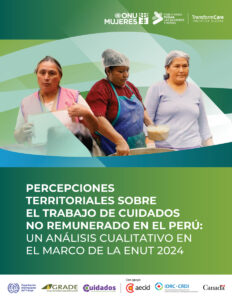
Percepciones Territoriales sobre el trabajo de cuidados no remunerada en el Perú: Un análisis cualitativo en el marco de la ENUT 2024
| Year | : | 2026 |
|---|---|---|
| Author/s | : | Lorena Alcazar, Vanessa Rojas |
| Area/s | : | Ethnicity, gender and citizenship |
ONU Mujeres y GRADE (2026). Percepciones territoriales sobre el trabajo de cuidado no remunerado en el Perú: un análisis cualitativo en el marco de la ENUT 2024. Perú.
“How Do We Use Our Time in Peru?” is a publication produced by the United Nations Entity for Gender Equality and the Empowerment of Women (UN Women) and the Group for the Analysis of Development (GRADE), based on the main findings of the 2024 National Time Use Survey (ENUT) conducted by the National Institute of Statistics and Informatics (INEI).
The study analyzes how the unequal distribution of time devoted to unpaid care work is a structural problem in Peru, marked by persistent traditional gender norms, institutional fragmentation, and informal employment, which keep households as the primary caregivers.
In light of this, the report highlights the need to advance comprehensive public policies that promote social and male shared responsibility, strengthen coordination among sectors and levels of government, incorporate time considerations into policy design and evaluation, and recognize the contribution of community organizations. It also underscores the importance of adopting a territorial approach that addresses the specific characteristics of Metropolitan Lima, Arequipa, and San Martín to move toward a more just, equitable, and sustainable social organization of care.
Through this publication, the authors seek to contribute to reflection and dialogue on the importance of recognizing and valuing domestic and care work in order to advance toward sustainable development without leaving anyone behind.