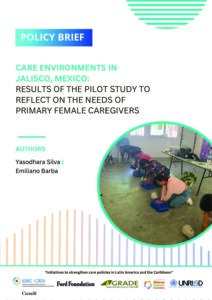
Care Environments in Jalisco, Mexico: Results of the Pilot Study to Reflect on the Needs of Primary Women Caregivers.
| Year | : | 2025 |
|---|---|---|
| Author/s | : | Yasodhara Silva, Emiliano Barba |
| Area/s | : | Ethnicity, gender and citizenship |
Silva, Y. & Barba, E. (2025) Care Environments in Jalisco, Mexico: Results of the pilot study to reflect on the needs of primary women caregivers. [Policy brief] Project Initiatives to strengthen care policies in Latin America and the Caribbean.
This policy brief presents the evaluation of the pilot study of the Care Environments Model in the Guadalajara Metropolitan Area. Inspired by Bogotá’s Care Blocks, the program combined a six-module training path in physical and emotional well-being and productive skills with temporary care relief services in two contrasting institutional contexts: Zapopan and Tlajomulco de Zúñiga.
The evaluation shows positive impacts on the participants’ emotional well-being, an 83.6% increase in certified training, and improvements in generating their own income. However, the study shows that the overall reduction in time spent on caregiving at home was limited due to the short duration of relief during the sessions, the persistent lack of male co-responsibility, and significant gaps in the municipalities’ prior institutional capacity to sustain the service.
Based on these results, the publication formulates recommendations to link this model to the State and Municipal Care Systems, expand the public offer with specialized services (care for dependent elderly people with adapted transportation, neurodivergence, and mental health), involve the private sector with flexible work schemes, and ensure budget allocations that go beyond election cycles.